Da Gadgetz

All about the latest technological gadgets


Not long ago a motorcycle with a fuel gauge was basically unheard of and even "low fuel" idiot lights were rare. Riders used advanced (and generally inaccurate) mathematics to calculate remaining mileage and, when the engine inevitably sputtered, switched over to a reserve tank that would let them nervously motor along a few more miles. Reva, an Indian company set to start shipping electric cars next year, plans to resurrect that most irritating sequence of events in their two-door NXR -- albeit with a modern spin. Now, instead of reaching down and turning a dial to get to that precious extra juice, drivers will need to call or text Reva HQ. Some overworked customer service agent will then remotely activate the "reserve battery," which surely doesn't even exist, to give a bit of extra range. We pity the fool who runs out of charge somewhere outside of cell range, but not quite as much as the designer who pitched this terrible idea.


Ever drive on the highway and think about how much solar energy is wasted on the asphalt below? Apparently, so has Solar Roadways. The startup was awarded a $100,000 U.S. Department of Transportation (DOT) grant this week to prototype its Solar Road Panel–an energy-generating panel made from solar cells and glass that is meant to replace petroleum-based asphalt on roads and in parking lots.The panels, designed by Solar Roadways founder Scott Brusaw, contain embedded LED lights that might eventually act as a “smart” system, providing travel lines as well as timely warnings to drivers about roadblocks and wildlife up ahead. At the same time, embedded heating elements in the panels could prevent snow and ice from building up on the road.Once a prototype is complete, Solar Roadways still has a long ways to go before its technology is commercialized. But if and when it is, Brusaw estimates that covering the entire U.S. interstate highway system with his 12′ by 12′ panels could fulfill the country’s energy needs (based on each panel producing 7.6 kilowatt hours of power each day).


Something about Le Petit Prince, the mobile, plant-loving greenhouse robot makes us indescribably sad. Is it his one, massive adorable eye? Or merely the fact that he's named after one of the most depressing books ever written? Either way, we can't really argue with his usefulness -- the concept can carry about plants and care for them, all the while ravaging the terrain for further specimens. He's also designed to learn about the optimal growing conditions of the plants he collects, which really makes us want one to care for a certain, finicky houseplant we won't call out by name (but we're looking at you, Venus Flytrap). Check out the darling video after the break.


The Copenhagen Consensus Centre—a respected European think tank which used to be skeptic on climate change—is now advising that we should spend $9 billion in building 1900 cloud-generating ships like the one above. Why? To cool down Earth:

When you spray saltwater into the air, you create nuclei that cloud condenses around, creating bigger and whiter clouds, thus bouncing more sunlight back into space.That's what David Young, a member of the panel that created the report, says. The fully automated vessels will cross the oceans absorbing water and spraying it into the skies. They say this will help the formation of big, whiter clouds, which will make the sun light bounce, lowering temperatures.

The idea seems neat, but the concept of anyone in planet Earth claiming to understand how climate works to this extend blows my mind. We are still trying to grasp how a complex system like the weather works, but someone wants to put an idea like this in motion, without knowing about the ultimate consequences? Like we say in my home country: Do you experiments with pop soda.[via Copenhagen Consensus]


Sakku has introduced the Solar Buddy for those who just need something tossed over their shoulder, and while the solar panel is unmistakable, the bag still manages to go easy on the eyes. Reportedly, the knapsacks are constructed from recycled material, and while the “direct” model charges portable gadgetry directly (big shock, right?), the “akku” model actually includes a battery pack that can be juiced for use in darkened alleyways and the like. A tad steep at €175 ($271) / €245 ($380) in order of mention, but it’s probably a design premium we’d be willing to pay.


The Solar Digital Audio Player, from the front, looks like any other ho hum unit, with a 1.8-inch 220 x 176 resolution display, 4GB of internal storage space and a miniSD expansion slot. Flip ‘er over, and you’ll find a thoughtful kickstand that just so happens to have a solar panel slapped right on, enabling the brilliant, outdoor sunshine to give it a few more minutes of life. There’s no official word on a price or release date,.


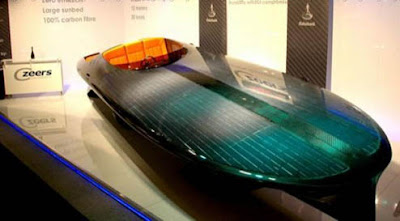
Looking to zoom through the oceans in a stylish, but also somewhat environmentally friendly, manner? Check out the Czeers MK1 prototypesolar speedboat, a 10-meter long rig that manages to pack in 14 square meters of solar panels to power an 80kw electric motor. The MK1 plows through the water at a breakneck 30 knots, using no oil and producing no fumes or engine noise. Hit the jump for a video of the boat in action.

The boat is made from 100 percent carbon fiber and has an LCD touch-screen control system, leather trimmings and, most importantly, photovoltaic cells on almost all its horizontal services. Czeers is hoping to produce between 4 and 8 boats per year. Pricing is not yet available, but considering that the last version of the MK1 was last shown at the Millionaire Fair, you can probably bet it’s super expensive. click on the image for the vedio